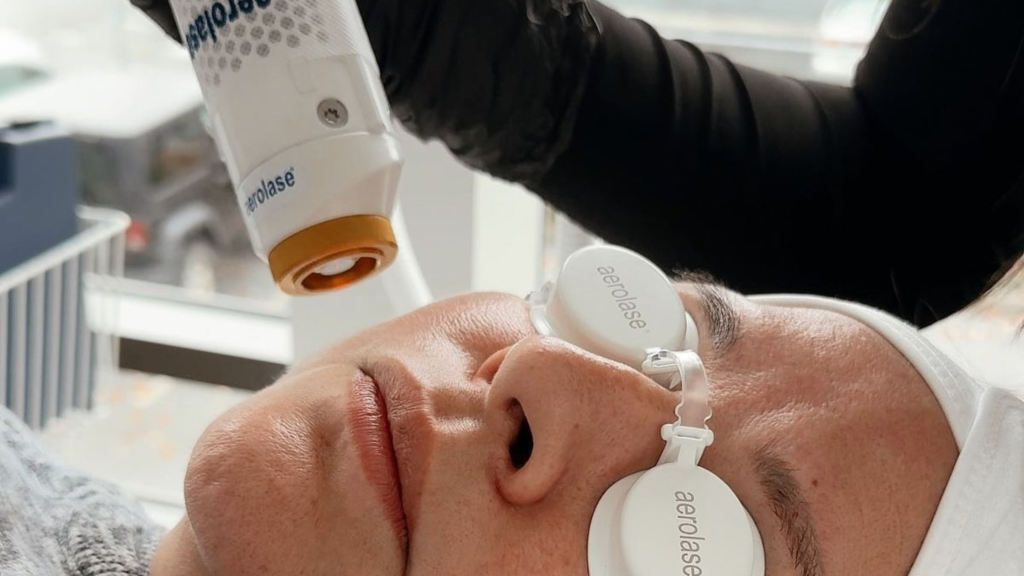
Aerolase vs IPL in Reno is one of the most important comparisons patients should understand before choosing a laser or light-based skin treatment. Many people hear the terms Aerolase, IPL, BBL, photofacial, laser facial, and skin rejuvenation used almost interchangeably. But these treatments are not the same.
Aerolase vs IPL in Reno is also a helpful way to understand how Aerolase compares with BBL, since IPL and BBL are both broad-spectrum light treatments often used for photofacial-style skin rejuvenation.
At Bella Derma Skin Care Solutions in Reno, we believe the best results come from choosing the right technology for the right skin concern, the right skin tone, and the right long-term treatment plan. IPL and BBL can be helpful for certain patients, especially those with sun damage, brown spots, redness, and photoaging. But Aerolase Neo Elite offers a very different approach.
Aerolase Neo Elite is a 1064nm Nd:YAG laser that uses a proprietary 650-microsecond pulse duration. Aerolase describes the Neo Elite as a device designed to treat more than 30 skin concerns, including acne, melasma, rosacea, pigmentation, vascular concerns, and signs of aging.
IPL, which stands for intense pulsed light, is not technically a laser. It uses broad-spectrum light filtered to target certain colors in the skin, such as red vessels or brown pigment. BBL, or BroadBand Light, is an advanced form of pulsed light technology associated with Sciton. Sciton describes BBL HEROic as a pulsed light device designed for consistent delivery of controlled light energy.
The question is not, “Is Aerolase always better than IPL or BBL?” The better question is, “Which treatment is safest, most appropriate, and most strategic for your skin?”
That answer depends on your goals, skin tone, pigmentation pattern, redness pattern, acne history, melasma risk, sun exposure, lifestyle, and whether your concern is surface-level discoloration, deeper inflammation, vascular activity, oil gland activity, or overall skin health.
Aerolase vs IPL in Reno: What Patients Should Know First
Aerolase vs IPL in Reno is an important comparison because these treatments are often grouped together, even though they use different technology and may be better suited for different skin concerns. Aerolase is a true 1064nm laser, while IPL and BBL use broad-spectrum light. The right choice depends on your skin tone, redness, pigment pattern, acne history, melasma risk, sun exposure, and long-term skin goals.
Why Patients Compare Aerolase, IPL, and BBL
Most patients are not trying to become laser experts. They simply want clearer, calmer, brighter, smoother-looking skin.
They may be dealing with:
- Sun damage from years of Reno and Tahoe outdoor exposure
- Redness or rosacea
- Brown spots
- Uneven tone
- Melasma
- Acne or acne marks
- Broken capillaries
- Enlarged-looking pores
- Dullness
- Early signs of aging
- Sensitive skin that reacts easily
- Skin of color concerns
- Past bad experiences with heat-based treatments
That is why comparison matters. Light and laser treatments are not one-size-fits-all. A device that works beautifully for one person’s sun spots may not be ideal for another person’s melasma. A treatment that is appropriate for a lighter skin type may require much more caution for a deeper skin tone. A treatment that targets visible brown pigment may not address acne inflammation or deeper vascular activity.
IPL and BBL are often chosen for photofacial-style treatments. They can be excellent tools in the right candidate. IPL is commonly used for red and brown discoloration, including certain vascular and pigmented lesions. DermNet describes IPL as light therapy that can target hemoglobin in blood vessels and melanin in pigmented lesions.
Aerolase is different because it is a true laser with a specific 1064nm wavelength and very short 650-microsecond pulse duration. That combination allows Aerolase to target deeper skin structures while keeping the treatment comfortable and generally low-downtime for many patients.
At Bella Derma, this difference matters because many Reno patients do not have just one concern. They may have acne plus redness. Melasma plus sensitivity. Sun damage plus post-inflammatory pigmentation. Rosacea plus aging skin. A one-dimensional approach may not be enough.
What Is Aerolase Neo Elite?
Aerolase Neo Elite is a 1064nm Nd:YAG laser. Unlike IPL or BBL, which use broad-spectrum light, Aerolase uses one specific wavelength of laser energy.
That 1064nm wavelength is important because it can penetrate deeper than many light-based treatments and can interact with multiple targets in the skin, including vascular redness, inflammation, oil-related acne activity, hair follicles, and pigmentation concerns.
Aerolase also uses a 650-microsecond pulse duration. In simple terms, the energy is delivered very quickly. Aerolase promotes this short pulse duration as part of what makes the treatment comfortable, versatile, and suitable for a broad range of skin types.
At Bella Derma, Aerolase is especially valuable because it can be used as part of a skin-health strategy, not just a “spot treatment” strategy. It may be considered for patients struggling with acne, rosacea, redness, melasma, post-inflammatory pigmentation, skin rejuvenation, and overall skin clarity.
This does not mean every person should receive the same settings, same number of treatments, or same treatment interval. It means the technology gives the provider more flexibility to customize the treatment based on the patient’s concern, skin type, and sensitivity level.
What Are IPL and BBL Photofacials?
IPL stands for intense pulsed light. It is often called a photofacial. IPL uses multiple wavelengths of light instead of one laser wavelength. Filters are used to narrow which parts of the light spectrum reach the skin.
IPL is commonly used for:
- Brown sun spots
- Freckling
- Redness
- Broken capillaries
- Diffuse flushing
- Uneven tone
- General photoaging
BBL stands for BroadBand Light. BBL is a more advanced version of pulsed light technology, commonly associated with Sciton. It is still not the same thing as a true laser. It uses controlled broad-spectrum light to target selected concerns in the skin. Sciton describes BBL as technology using controlled light energy to target skin concerns without affecting surrounding tissue unnecessarily.
For many patients, IPL and BBL can produce a brighter, more even-looking complexion. They can be especially helpful for visible sun damage in lighter skin types. However, they are more dependent on careful patient selection, skin tone evaluation, recent sun exposure history, and the type of pigmentation being treated.
That matters greatly in Reno, where high-altitude sun exposure, outdoor lifestyles, and year-round UV exposure can influence treatment risk and long-term results.
When patients compare Aerolase vs IPL in Reno, BBL should remain part of the discussion because BBL is one of the most recognized broadband light treatments for sun damage, redness, pigment, and photofacial-style rejuvenation.
Is BBL the Same as IPL?
BBL and IPL are closely related, but they are not identical. IPL stands for intense pulsed light and refers broadly to treatments that use filtered broad-spectrum light to target pigment, redness, and signs of sun damage. BBL stands for BroadBand Light and is a specific advanced light-based platform often used for photofacial-style rejuvenation.
For patients comparing Aerolase vs IPL in Reno, BBL belongs in the same conversation because both IPL and BBL use broad-spectrum light rather than one focused laser wavelength. The key difference is that Aerolase Neo Elite is a true 1064nm laser, while IPL and BBL are light-based systems.
This matters because the safest treatment is not always the most popular treatment. Some patients may be better candidates for IPL or BBL, especially if they have lighter skin and visible sun damage. Others may be better suited for Aerolase if they have melasma-prone skin, acne, redness, deeper skin tone, sensitivity, or mixed concerns.
The Biggest Difference: Laser Energy vs Broad-Spectrum Light
The most important difference between Aerolase and IPL/BBL is the type of energy used.
Aerolase is a laser. That means it uses a single wavelength of light: 1064nm. This gives the treatment a more specific, focused energy profile.
IPL and BBL use broad-spectrum light. This means they emit a range of wavelengths, with filters used to target certain concerns.
Think of it this way:
Aerolase is like a highly specific tool designed to reach certain targets with one precise wavelength.
IPL and BBL are like broader light-based platforms that can be adjusted with filters to treat red and brown discoloration.
Both approaches can be useful. But they behave differently in the skin.
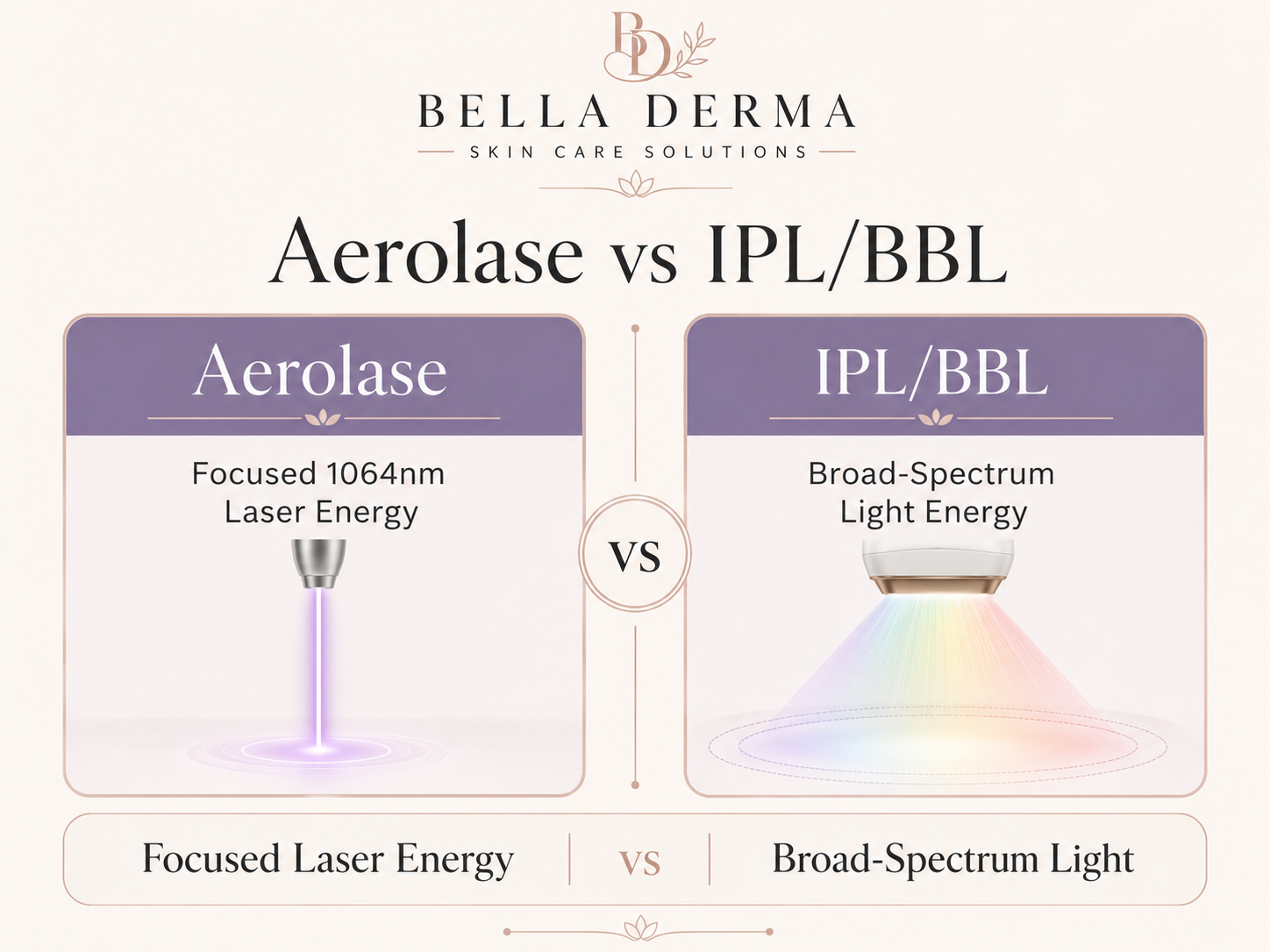
Because IPL and BBL often target visible pigment closer to the surface, they can be very appealing for sun spots and photodamage. Because Aerolase uses a 1064nm wavelength, it can be especially useful when a provider wants deeper penetration, broader skin-type flexibility, and a treatment that may be appropriate for inflammatory concerns like acne and redness.
The foundation of Aerolase vs IPL in Reno also applies to BBL: Aerolase uses a single focused 1064nm laser wavelength, while IPL and BBL use broader light energy filtered for different skin concerns.
Difference #1: Aerolase May Be More Skin-Tone Inclusive
One of the most important advantages of Aerolase is its potential use across a wider range of skin tones. Aerolase describes its 650-microsecond technology as suitable for all Fitzpatrick skin types I–VI.
This is especially important for patients with medium, olive, brown, or deeper skin tones. These patients may be more vulnerable to post-inflammatory hyperpigmentation if a light or laser treatment creates too much heat, irritation, or inflammation.
IPL can be appropriate for some patients, but it is often considered more limited in darker skin tones. UT Southwestern notes that ideal IPL candidates are often lighter to medium skin tones, and that darker skin tones or melasma may not be good candidates because IPL can worsen hyperpigmentation or existing discoloration.
This is not because IPL is “bad.” It is because IPL targets pigment, and in deeper skin tones there is more background melanin. That increases the need for careful screening, conservative settings, and sometimes choosing a different technology entirely.
At Bella Derma, this is a major reason we take consultation seriously. The right device is not just about the concern. It is about the person.
For patients with deeper skin tones, melasma risk, or a history of post-inflammatory hyperpigmentation, Aerolase vs IPL in Reno should also include a careful conversation about whether BBL is appropriate or whether Aerolase may be the more conservative option.
Difference #2: Aerolase May Be Better Suited for Melasma-Prone Skin
Melasma is one of the most misunderstood pigmentation concerns. Many patients think melasma is simply “brown spots.” But melasma behaves differently than sun spots.
Melasma is chronic, reactive, and often influenced by heat, hormones, inflammation, and UV exposure. For patients researching pigmentation treatments, the American Academy of Dermatology explains why proper diagnosis and treatment planning matter for melasma. The American Academy of Dermatology notes that melasma treatment in darker skin tones requires a different approach because irritation can worsen pigmentation.
This is why IPL and BBL require caution for melasma-prone patients. IPL may improve certain superficial pigmentation concerns, but it can also trigger rebound pigmentation or worsen discoloration in the wrong candidate. A review in the Journal of the American Academy of Dermatology notes that IPL can be effective for dyschromia but has higher risk of recurrence and post-inflammatory hyperpigmentation, especially in darker skin tones.
Aerolase is often attractive for melasma-prone patients because it can be used in a gentler, more strategic way as part of a pigment-control plan. That may include medical-grade skincare, strict sunscreen use, barrier support, and maintenance treatments.
At Bella Derma, we do not present melasma as a quick-fix concern. We present it as a long-term skin management condition. The safest approach is not always the most aggressive approach. In many cases, the best melasma strategy is calm, consistent, and customized.
That is why Aerolase vs IPL in Reno is not just a device comparison — it is also a safety conversation that includes BBL, especially for patients with melasma-prone or heat-reactive pigmentation.
Difference #3: Aerolase Can Be Valuable for Acne, Not Just Pigment
IPL and BBL are often discussed in the context of photofacials: brown spots, redness, and sun damage. Aerolase, however, can also be used as part of an acne treatment strategy.
Aerolase promotes Neo Elite for acne, and a cited clinical study evaluated treatment of mild to severe acne vulgaris with a 650-microsecond 1064nm Nd:YAG laser.
This matters because many patients with acne do not only have breakouts. They may also have redness, inflammation, post-acne marks, uneven tone, and sensitivity. A treatment that only targets pigment may not address the deeper acne pattern.
Aerolase can be especially helpful for patients who want a treatment that supports clearer-looking skin without relying only on harsh topical products, oral medications, or aggressive resurfacing. It can also pair well with a professional acne program, such as a structured regimen using acne-safe home care, lifestyle guidance, and regular follow-up.
At Bella Derma, Aerolase is not used as a random “zap the breakout” treatment. It is best positioned as part of a comprehensive skin-clearing plan.
For acne-prone patients, Aerolase vs IPL in Reno often comes down to whether the goal is photofacial-style brightening with IPL or BBL, or a more acne-focused laser strategy with Aerolase.
Difference #4: IPL/BBL Can Be Excellent for Certain Sun Damage
There are situations where IPL or BBL may be very appropriate. A patient with lighter skin, visible sun spots, freckles, broken capillaries, and minimal melasma risk may be a strong candidate for IPL or BBL.
IPL can target brown pigment and red vessels. DermNet describes IPL as targeting melanin for pigmented lesions and hemoglobin for vascular lesions.
This is why IPL photofacials became so popular. They can create a brighter, more even-looking complexion when the candidate is well-selected.
BBL can also be a powerful option for photoaging and discoloration. Sciton’s BBL platform is designed around controlled light delivery and filter-based treatment customization.
The key is that IPL/BBL should not be treated as “safe for everyone” simply because it is common. It is still a heat-based energy treatment. The provider must consider skin tone, melasma risk, recent tanning, medications, photosensitivity, sensitivity history, and post-care compliance.
In Reno, this matters because patients often have significant sun exposure from skiing, hiking, boating, golfing, biking, running, and high-desert outdoor living.
Difference #5: Reno’s High-Desert Climate Changes the Conversation
Reno skin is not always the same as coastal skin. Our climate is dry, sunny, high-altitude, and often dehydrating. That combination can make skin more reactive.
Patients in Reno and Tahoe often deal with:
- More UV exposure than they realize
- Dryness and barrier stress
- Outdoor lifestyle pigmentation
- Redness from wind, heat, cold, and sun
- Increased sensitivity after travel or seasonal changes
- Dehydrated skin that looks dull or crepey
- Pigment that worsens after sun exposure
This does not mean patients should avoid light and laser treatments. It means the treatment plan must be smarter.
For IPL/BBL, recent sun exposure or tanning can increase risk. DermNet lists sun exposure among contraindications for IPL in acne-related light treatments, and StatPearls notes that inappropriate settings or excess energy can lead to thermal damage and complications.
For Aerolase, the ability to provide a generally low-downtime laser treatment can be valuable for patients who want results without a long recovery window. But even with Aerolase, sun protection is still essential. No laser can outwork repeated UV exposure, inconsistent sunscreen, or poor barrier care.
At Bella Derma, we do not just treat the skin. We educate patients on how to protect their results in the real world.
Because Reno’s high-desert climate creates so much sun exposure, dryness, and pigment risk, Aerolase vs IPL in Reno should always include BBL in the discussion, especially for patients considering photofacial treatments.

Difference #6: Downtime and Social Recovery May Feel Different
Most patients want visible improvement without looking obviously “treated.” This is where Aerolase can be especially appealing.
Many Aerolase treatments are comfortable, quick, and associated with minimal visible downtime for many patients. Aerolase markets Neo Elite as a no-downtime treatment platform for many indications.
IPL and BBL can also have limited downtime, but the visible recovery may vary depending on the concern treated. Brown spots may darken temporarily before flaking or fading. Redness and swelling can occur. Some patients may need to avoid certain activities, sun exposure, heat, and exfoliation.
StatPearls notes that IPL side effects are usually rare and minimal in severity, but possible adverse effects include pain, redness, swelling, crusting, pigment changes, blistering, scarring, and infection.
This is why a careful consultation matters. “No downtime” should never mean “no rules.” Even low-downtime treatments require proper aftercare.
Difference #7: Aerolase May Be More Versatile for Mixed Concerns
Many patients do not fit neatly into one category.
Someone may come in asking for a photofacial but actually have melasma. Another patient may ask for treatment for acne scars but still have active acne. Someone else may think they need brown spot removal, when much of the concern is redness, inflammation, and barrier damage.
Aerolase can be a strong option for mixed concerns because it may be used for redness, acne, pigmentation, and rejuvenation-style goals. Aerolase describes Neo Elite as treating acne, melasma, rosacea, vascular lesions, and other concerns.
IPL/BBL can also treat multiple concerns, especially redness and brown spots, but patient selection is critical.
The biggest mistake patients make is choosing a treatment based on a device name instead of a diagnosis. At Bella Derma, we want patients to understand what is actually causing the concern before choosing a treatment.
Aerolase vs IPL/BBL: Simple Comparison
| Concern | Aerolase Neo Elite | IPL/BBL |
|---|---|---|
| Technology type | True 1064nm Nd:YAG laser | Broad-spectrum pulsed light |
| Common use | Acne, redness, melasma support, vascular concerns, pigmentation, rejuvenation | Sun spots, redness, photofacial, visible discoloration |
| Skin tone flexibility | Often more inclusive across skin types | Usually more limited in deeper skin tones |
| Melasma-prone skin | Often considered more strategic and conservative | Requires caution; may worsen pigmentation in some patients |
| Acne support | Stronger role in acne-focused protocols | May help some inflammation/redness but less acne-specific |
| Brown sun spots | Can help certain pigment concerns | Often strong for superficial sun damage in ideal candidates |
| Downtime | Usually minimal for many patients | Often minimal, but pigment darkening/flaking/redness may occur |
| Best use | Mixed concerns, sensitive skin strategies, acne/redness/melasma-prone patients | Lighter skin types with sun damage and clear IPL candidacy |
This Aerolase vs IPL in Reno comparison shows why BBL remains important to discuss: IPL and BBL may be excellent for certain photodamage concerns, while Aerolase may be better suited for acne, melasma-prone skin, redness, and mixed sensitivity concerns.
Is Aerolase Better Than IPL?
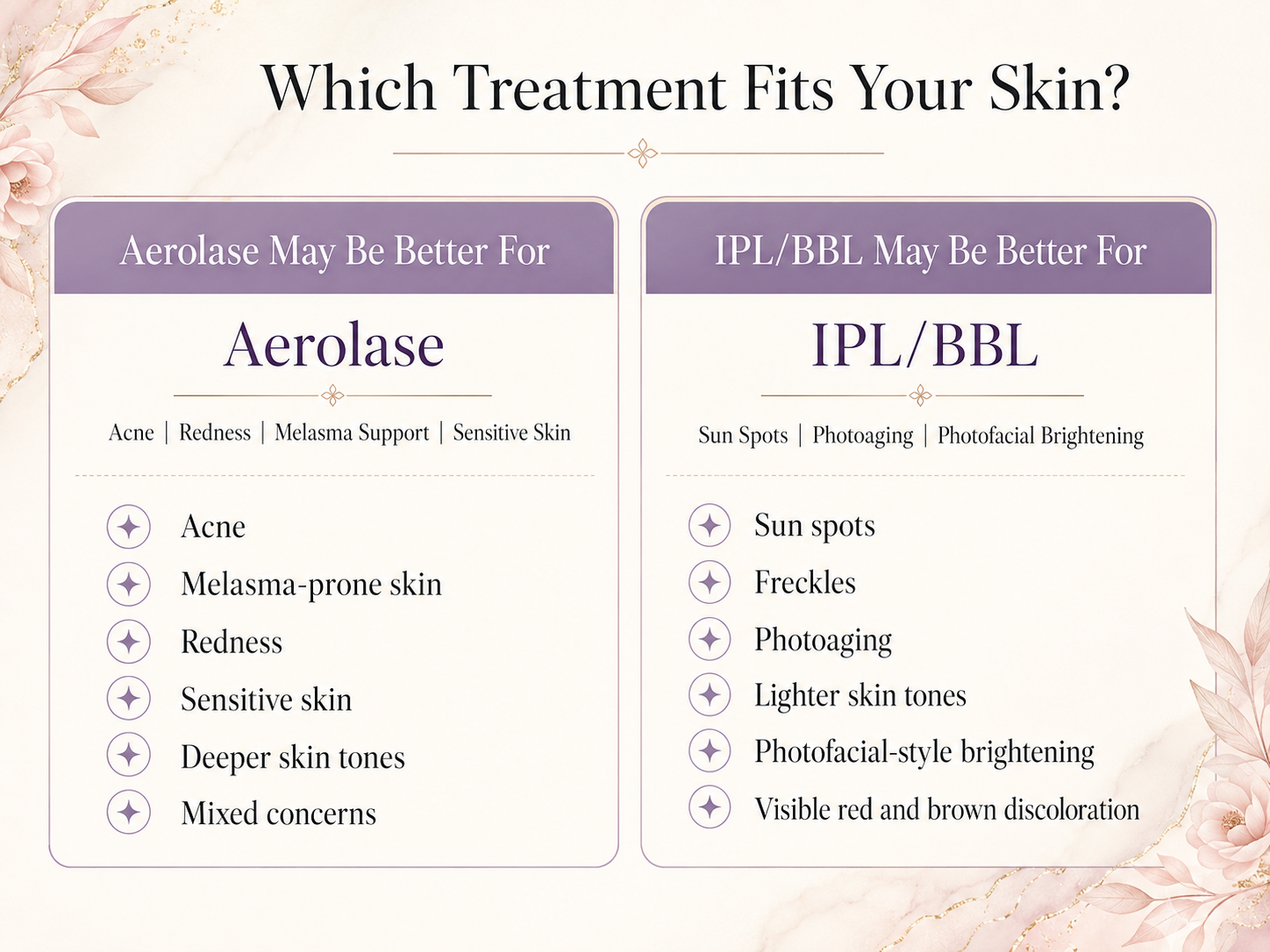
Aerolase may be better than IPL for certain patients, especially those with acne, melasma-prone pigmentation, sensitive skin, skin of color, mixed redness and pigment, or concerns about downtime.
But IPL may be appropriate for other patients, especially those with lighter skin types and visible sun damage who are good candidates for a photofacial-style treatment.
The best choice depends on evaluation.
At Bella Derma, we do not believe in forcing every patient into the same treatment. We believe in choosing the most appropriate path based on your skin.
Is Aerolase Better Than BBL?
BBL is a respected technology and can be excellent for the right candidate. However, Aerolase and BBL are fundamentally different.
BBL is broadband light. Aerolase is a true 1064nm laser.
BBL may be excellent for photodamage, brown spots, redness, and photoaging in appropriate patients. Aerolase may be more versatile for patients who need a skin-tone-inclusive, acne-friendly, redness-friendly, melasma-aware, low-downtime option.
So the better question is not “Which device is more famous?” The better question is, “Which device is safer and more strategic for this specific patient?”
Aerolase vs IPL in Reno naturally leads to the BBL conversation because many patients are deciding between Aerolase, IPL photofacials, and BBL photofacials before choosing a treatment.
Who May Be a Good Candidate for Aerolase?
You may be a good candidate for Aerolase at Bella Derma if you are concerned about:
- Acne
- Acne redness
- Rosacea
- Facial redness
- Melasma
- Post-inflammatory hyperpigmentation
- Uneven tone
- Sensitive or reactive skin
- Early aging changes
- Dullness
- Enlarged-looking pores
- Mixed skin concerns
- Desire for little to no social downtime
- Need for a more skin-tone-inclusive laser option
Aerolase may also be attractive for patients who have been told they are not ideal IPL candidates because of skin tone, melasma risk, or sensitivity.
Who May Be a Better Candidate for IPL or BBL?
A patient may be a better IPL or BBL candidate if they have:
- Lighter skin tone
- Clear sun spots or freckles
- Visible photoaging
- Red and brown discoloration
- No active tan
- No significant melasma tendency
- No history of pigment worsening after heat
- Ability to follow strict sun avoidance and aftercare
- A desire for photofacial-style brightening
This is why IPL and BBL are still popular. They can be very effective for the right person. The issue is not whether they work. The issue is whether they are the right treatment for your specific skin.
When IPL/BBL May Not Be the Best First Choice
IPL or BBL may not be the best first choice if you have:
- Melasma
- Deeper skin tone
- Recent tanning
- Frequent sun exposure
- Active inflammation
- Heat-triggered pigmentation
- History of post-inflammatory hyperpigmentation
- Very sensitive skin barrier
- Poor sunscreen habits
- Unclear diagnosis of brown spots
- Active acne as the main concern
In those situations, a gentler, more customized strategy may be safer. That may include Aerolase, medical-grade skincare, acne-safe products, pigment control, barrier repair, LED therapy, microneedling, or other options depending on the concern.
Why Consultation Matters More Than the Device Name
Patients often arrive asking for the treatment they saw online. That is understandable. But online treatment names do not always match what your skin actually needs.
For example:
A patient may ask for IPL for brown spots, but the real concern may be melasma.
A patient may ask for BBL for redness, but the redness may be rosacea plus barrier damage.
A patient may ask for laser resurfacing for texture, but the skin may need acne control first.
A patient may ask for “the strongest treatment,” but their skin may need a conservative plan to avoid pigmentation problems.
At Bella Derma, the goal is not to sell the most aggressive treatment. The goal is to recommend the right treatment.
That is part of our philosophy: bringing bedside manner back to the medspa experience. Patients deserve education, not pressure. They deserve a provider who explains why a treatment is recommended, what it can realistically improve, what it cannot fix, and how to protect results afterward.
At Bella Derma, Aerolase vs IPL in Reno is never treated as a simple either-or decision. We also consider BBL, skin tone, pigment pattern, acne history, redness, sensitivity, sun exposure, and long-term maintenance goals.
Aerolase for Redness vs IPL/BBL for Redness
Redness is one of the most common reasons patients consider laser or light-based treatments.
IPL and BBL can be effective for certain vascular redness concerns. The American Academy of Dermatology notes that lasers and light treatments can reduce redness and visible blood vessels in rosacea, although results vary.
Aerolase may also be used for redness and rosacea-related concerns. Because Aerolase can target vascular and inflammatory components, it can be a strong option for patients whose redness is not just superficial broken capillaries but part of a broader inflammatory skin pattern.
At Bella Derma, we look at the type of redness:
- Is it flushing?
- Is it visible capillaries?
- Is it rosacea?
- Is it acne-related redness?
- Is it irritation from products?
- Is it barrier damage?
- Is it heat-triggered?
- Is it mixed with pigmentation?
The more complex the redness, the more important customization becomes.
Aerolase for Pigmentation vs IPL/BBL for Pigmentation
Pigmentation is another area where the right diagnosis is everything.
IPL and BBL may be excellent for sun spots, freckles, and superficial photoaging in the right candidate.
Aerolase may be preferred when pigmentation is more complex, especially if there is melasma, post-inflammatory pigmentation, skin of color, or sensitivity.
The difference matters because brown pigment is not always the same. Sun spots, freckles, melasma, post-acne marks, and post-inflammatory hyperpigmentation can all look like “brown spots” to the patient. But they do not behave the same way.
Treating the wrong pigment with the wrong heat-based treatment can make the concern more stubborn.
Because different pigmentation patterns behave differently, our guide to dark spots in Reno explains seven reasons brown marks and uneven pigment can remain stubborn or recur.
Why can dark spots be so stubborn?
May Belle Fellenz, APRN, MSN, FNP-BC, explains several reasons pigmentation may take time to improve, including UV exposure, irritation, skin turnover, and consistency with treatment.

Sun spots, melasma, and post-inflammatory pigmentation can look similar, but they often require different treatment strategies.
Aerolase for Acne vs IPL/BBL for Acne
For acne, Aerolase often has a clearer role than IPL/BBL. Aerolase Neo Elite has been promoted for acne and studied for mild to severe acne vulgaris using the 650-microsecond 1064nm Nd:YAG laser.
IPL may help some inflammatory skin concerns, but acne treatment is usually more complex than simply reducing redness. Acne may involve oil production, clogged follicles, bacteria, inflammation, hormones, product triggers, lifestyle factors, and skin barrier issues.
At Bella Derma, acne is best treated with a complete plan. Aerolase may be part of that plan, but long-term success often also requires home care, product changes, consistency, and follow-up.
Aerolase for Skin Rejuvenation vs IPL/BBL Photofacial
For general rejuvenation, both Aerolase and IPL/BBL can have a role.
IPL/BBL photofacials are often chosen for visible sun damage, tone correction, and brightening.
Aerolase may be chosen for patients who want clearer, calmer, more even-looking skin with minimal downtime and a broader treatment strategy.
In Reno, many patients are not just looking for “glow.” They are looking for skin that looks healthier despite sun exposure, dryness, stress, travel, seasonal changes, and aging. Aerolase can fit well into a maintenance plan because it can address several skin-health concerns without requiring a dramatic recovery period for many patients.
How Many Treatments Are Needed?
The number of treatments depends on the concern.
A patient with acne may need a series. A patient with redness may need multiple sessions and maintenance. A patient with melasma may need ongoing management. A patient with sun damage may need a different schedule depending on pigment depth, skin tone, and sun exposure.
A good general rule is this: one treatment may create improvement, but a series usually creates a more meaningful change.
At Bella Derma, we prefer to build a plan rather than promise a one-session miracle. Skin changes over time. Results are best when professional treatments, home care, and lifestyle habits work together.
What to Expect After Aerolase
After Aerolase, many patients can return to normal daily activities quickly. Some may have temporary warmth, mild redness, or a flushed appearance. The exact response depends on the settings used, the concern treated, and individual skin sensitivity.
Patients should still follow aftercare instructions, including:
- Use gentle skincare
- Avoid harsh exfoliants temporarily
- Wear sunscreen daily
- Avoid intentional tanning
- Avoid overheating if instructed
- Follow provider recommendations
- Stay consistent with home care
Aerolase may feel easier than more aggressive treatments, but it still deserves respect. Energy-based treatments should always be performed thoughtfully.
What to Expect After IPL/BBL
After IPL or BBL, patients may experience redness, warmth, swelling, or darkening of pigmented spots before they fade. Some patients describe the darkened pigment as looking like coffee grounds before it flakes away.
However, recovery depends on the settings, the treated concern, and the patient’s skin. IPL side effects can include pigment changes, blistering, crusting, and other complications when settings are inappropriate or the patient is not a good candidate.
This is why IPL/BBL should never be treated casually. A photofacial is still a medical aesthetic treatment. Clinical education on intense pulsed light therapy notes that IPL uses varying wavelengths, durations, and energy settings, which is why patient selection and provider experience matter.
Why Bella Derma Chose Aerolase as a Signature Technology
Bella Derma Skin Care Solutions focuses on treatments that support beautiful results while respecting patient comfort, safety, and skin individuality.
Aerolase fits that philosophy because it is versatile, elegant, and strategic. It allows us to treat a wide range of concerns without making every patient feel like they need aggressive downtime or a harsh treatment experience.
For Reno patients, this matters.
Our patients are busy. They work, travel, attend events, spend time outdoors, and want their skin to look healthy without looking overdone. They want visible improvement, but they also want thoughtful care.
That is where Aerolase shines.
The Bella Derma Approach: Not Just “Laser,” But Skin Strategy
At Bella Derma, we do not view Aerolase as a standalone magic wand. We view it as part of a broader skin strategy.
That strategy may include:
- Aerolase laser therapy
- Medical-grade skincare
- Acne-safe product planning
- Face Reality acne support
- LED therapy
- Microneedling
- VAMP Advanced
- PRX Derm Perfexion
- Hydration support
- Barrier repair
- Sun protection education
- Maintenance treatments
The best plan depends on the patient.
A patient with melasma does not need the same plan as a patient with acne. A patient with rosacea does not need the same plan as a patient with sun spots. A patient preparing for a wedding does not need the same plan as someone managing chronic inflammation.
That is why bedside manner matters. Good aesthetic care is not just about owning technology. It is about knowing when to use it, when not to use it, and how to explain the difference.
Final Answer: Aerolase vs IPL in Reno
Aerolase, IPL, and BBL can all be valuable tools in aesthetic medicine. But they are not interchangeable.
IPL and BBL may be excellent for certain patients with sun damage, redness, and lighter skin types who are good candidates for photofacial-style treatment.
Aerolase may be a better fit for patients who need a more versatile, skin-tone-inclusive, melasma-aware, acne-friendly, redness-friendly, low-downtime laser option.
For many Bella Derma patients, Aerolase offers the kind of modern treatment experience they are looking for: effective, comfortable, thoughtful, and customized.
The safest way to choose is not by guessing online. The safest way to choose is through a professional consultation where your skin tone, skin history, goals, lifestyle, sun exposure, and pigmentation pattern are carefully evaluated.
At Bella Derma Skin Care Solutions in Reno, our goal is to help you choose the treatment that makes the most sense for your skin — not just the treatment with the trendiest name.
Ready to find out whether Aerolase is right for you?
Schedule a consultation with Bella Derma Skin Care Solutions in Reno and let our team help you create a personalized plan for clearer, calmer, more radiant-looking skin.
If you are comparing Aerolase vs IPL in Reno, or wondering whether Aerolase, IPL, or BBL is the better fit for your skin, Bella Derma Skin Care Solutions can help you choose the safest and most strategic option.
FAQ Section
Is Aerolase the same as IPL?
No. Aerolase is a true 1064nm Nd:YAG laser. IPL uses intense pulsed light with multiple wavelengths. They are both energy-based treatments, but they work differently in the skin.
Is BBL the same as IPL?
BBL is a more advanced form of broadband pulsed light technology. It is similar in concept to IPL because it uses broad-spectrum light, but BBL devices have their own technology, filters, and delivery systems.
Is Aerolase better than IPL for melasma?
Aerolase may be a better choice for many melasma-prone patients because melasma can worsen with heat, inflammation, and overly aggressive treatments. IPL can be risky for some melasma patients, especially those with deeper skin tones or reactive pigmentation.
Is IPL better for sun spots?
IPL or BBL may be very effective for certain sun spots in lighter skin types. However, brown spots should be evaluated first to make sure they are not melasma or another pigmentation concern.
Is Aerolase safe for darker skin tones?
Aerolase is promoted as suitable for all Fitzpatrick skin types I–VI. A consultation is still important because settings, goals, and treatment plans must be customized.
Can Aerolase help acne?
Yes, Aerolase can be used as part of an acne treatment plan. It may help calm inflammation and support clearer-looking skin, especially when paired with a consistent acne-safe home care program.
Which has more downtime, Aerolase or IPL/BBL?
Aerolase is typically associated with minimal downtime for many patients. IPL and BBL can also have limited downtime, but brown spots may darken temporarily, and redness or swelling can occur.
Can I get Aerolase if I live an outdoor lifestyle in Reno or Tahoe?
Possibly, but sun protection is essential. Reno and Tahoe’s high-altitude sun exposure can worsen pigmentation and affect results. A provider should help you time treatments around sun exposure, travel, outdoor events, and seasonal activities.
Is BBL better than IPL?
BBL is often considered a more advanced broadband light treatment than traditional IPL, but the best choice depends on the patient. BBL may be excellent for certain types of sun damage, redness, and photofacial-style rejuvenation. However, patients comparing Aerolase vs IPL in Reno should also understand that BBL is still different from Aerolase because BBL uses broad-spectrum light, while Aerolase uses a focused 1064nm laser.
Is Aerolase better than BBL?
Aerolase may be a better option for patients with acne, melasma-prone pigmentation, redness, sensitive skin, deeper skin tones, or mixed concerns. BBL may be a better option for certain patients with lighter skin tones and visible sun damage. The right choice depends on your skin, not just the device name.
Share
Related posts